


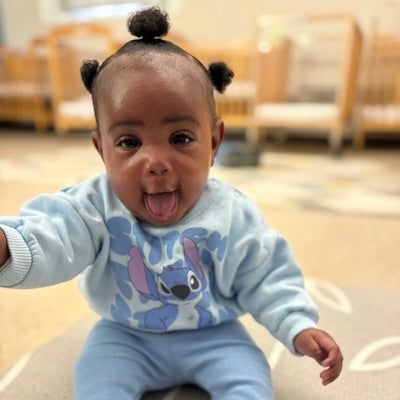
 When asked about her 6-month-old daughter, Kibriyaa Lindsey lights up. “Adaira loves to read,” says Kibriyaa. “She will stare down a book, and then the moment you start reading, she starts touching and turning the pages. I’m grateful because she loves to learn, and she reminds me of me when I was younger. She’s so inquisitive!”
Adaira’s birth at Boston Medical Center on April 19 was especially meaningful for Kibriyaa, whose first pregnancy in 2015 ended in miscarriage. “I wasn’t super far along, but the moment I found out I had miscarried, my whole world just changed right then and there,” she shares. “It definitely took a toll on my mental health.”
Challenges on the Path to Motherhood
After miscarrying, Kibriyaa was diagnosed with polycystic ovary syndrome (PCOS), a hormonal disorder that can cause fertility problems. She spent years trying to manage it by maintaining a healthier diet and lifestyle, but she still couldn’t get pregnant. On the advice of her care team, Kibriyaa scheduled a special X-ray at BMC, called a hysterosalpingogram (HSG), that would identify any problems with her uterus or fallopian tubes. While she waited to have her appointment, she missed her period, which isn’t unusual for women with PCOS, so she didn’t think much of it.
But Kibriyaa’s coworkers at the State of Massachusetts were concerned. “I was feeling really weird one day, and they were like, ‘Are you sure you’re not pregnant? You need to go to the hospital because you’re not looking like yourself.’ I thought I couldn’t get pregnant naturally, so I went to BMC thinking I had a stomach bug.”
That’s when Kibriyaa found out she was pregnant with Adaira. She was thrilled—and nervous.
 Finding the Right Fit for Her Prenatal Care
Kibriyaa started her prenatal care with an obstetrician, but early on in her pregnancy she had an appointment with Rosha Forman, MSN, CNM, the director of Midwifery Services at BMC. “Rosha said, ‘I’m here for you. Talk to me. Let me know all your concerns.’ It felt like she really cared about what I had going on,” says Kibriyaa. “After meeting with her that one time, I automatically knew that I wanted to go the midwives’ route for the rest of my pregnancy.”
Throughout her pregnancy, Kibriyaa stayed in close touch with the midwifery team. “Every morning, I would wake up wondering, what’s going on? Have I felt my baby move?” she says. “When you turn to Google, you find things that you may not like.” So, she was thankful that the midwives’ pager line was always available when she felt like something was off and needed reassurance. “Pregnancy is a very vulnerable time. Whenever I reached out to the midwives with concerns and heard back, ‘That’s normal,’ it was such a relief. Especially to hear that from someone who knows. Every midwife I saw during my pregnancy was amazing.”
Kibriyaa had a smooth pregnancy—until 41 weeks, when her baby didn’t pass the weekly nonstress test (NST), a routine test that monitors fetal movement. “They told me Adaira probably just didn’t have enough space,” says Kibriyaa. “I was like, ‘Let’s do this!” Rosha, who was down the hall at the time, agreed it was time to admit Kibriyaa to the hospital for labor and delivery.
 Adaira Arrives via C-Section
But Kibriyaa would have to wait a little longer to meet her baby. “I was induced, we did a bunch of exercises, we tried everything—but my baby just wasn’t able to descend,” explains Kibriyaa. After two days of labor, baby Adaira arrived via C-section, weighing 7 pounds, 14.5 ounces, and measuring 19.5 inches long.
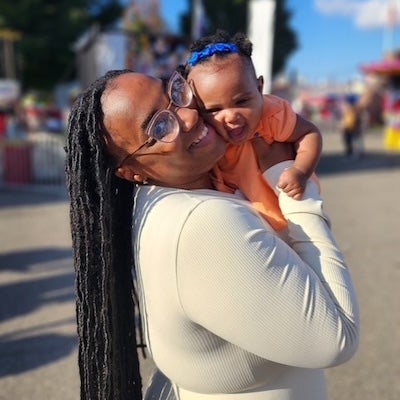
Kibriyaa has been enjoying motherhood ever since and hopes her story helps other parents feel empowered. “My experience wasn’t what I wanted for my birth,” admits Kibriyaa. “But you know what—Adaira is here, she’s happy, and she’s healthy. Despite going through all of that, it was worth it. I wanted to share my experience because I went into this with certain expectations—and things didn’t go as planned. But I want other women to know that that’s okay.”
Today, Kibriyaa is proud to share her wisdom and give back through her involvement in BMC’s Pregnancy Advisory Board, which is currently helping to make the hospital’s pregnancy and postpartum website more user-friendly. Her advice to other mothers-to-be: “Always do your research. Speak up. Advocate for yourself!”