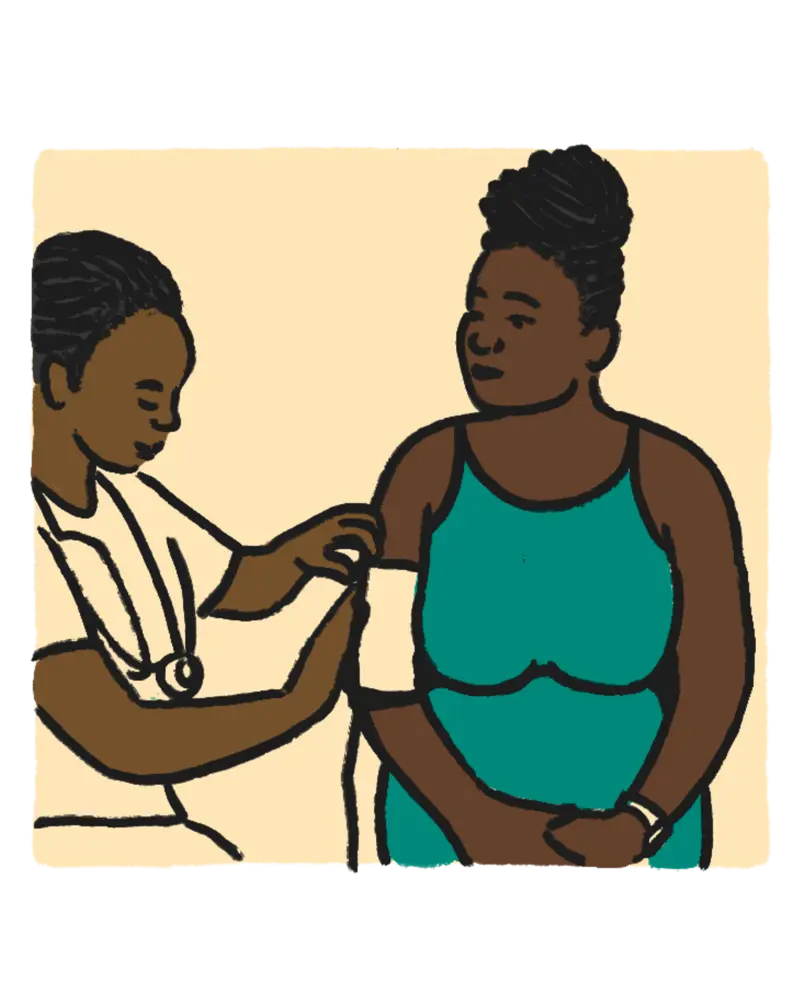
Testing for Gestational Diabetes

Gestational diabetes mellitus (GDM) is a type of diabetes that can develop during pregnancy. It happens when pregnancy hormones make it harder for your body to use insulin, causing your blood sugar to rise. High blood sugar can lead to health issues for both you and your baby.
Testing is a normal part of prenatal care and helps catch GDM early, so you and your provider can manage it together.
Why Do Some People Get Gestational Diabetes?
About six to eight percent of pregnant people are diagnosed with gestational diabetes.
You may be at higher risk if you:
- Are from certain higher-risk racial or ethnic groups
- Have a parent or sibling with diabetes
- Have polycystic ovary syndrome (PCOS)
- Have high blood pressure (hypertension)
- Are overweight or obese
- Have pre-diabetes, or had gestational diabetes in a past pregnancy
- Have previously given birth to a baby that weighed more than nine pounds
- Are pregnant with twins
- Are not not doing much daily movement or exercise
Talk with your provider about your risk factors.
How Do I Know if I Have Gestational Diabetes?
You may have one or more of the following tests during pregnancy:
Hemoglobin A1C Test
This blood test shows your average blood sugar over the last two to three months. It helps your provider understand how your body is managing sugar.
Gestational Diabetes One-Hour Glucola Test
This screening checks whether you might have gestational diabetes. It’s usually done between 24 and 28 weeks of pregnancy (around the sixth or seventh month).
What to Expect
- No fasting is needed. You can eat and drink normally before the test, unless your provider tells you otherwise.
- At the lab, you’ll drink a sweet liquid called Glucola.
- You’ll wait one hour. Bring something to read, listen to, or watch while you wait.
- After one hour, a blood sample will be taken to check your blood sugar level.
Understanding Your Results
- If your result is below 135, you likely do not have gestational diabetes.
- If your result is 135 or higher, you’ll need to take a follow-up test to confirm whether you have gestational diabetes.
Gestational Diabetes Three-Hour Glucola Test
If your one-hour Glucola test result was high, this follow-up test can confirm whether or not you have gestational diabetes.
What to Expect
- Fast before the test. Do not eat or drink anything (except small sips of water) for at least eight hours before your appointment.
- When you arrive, your blood will be drawn before drinking anything.
- You’ll then drink the sweet Glucola solution.
- Your blood will be drawn again at one hour, two hours, and three hours after you drink the solution.
- Plan to stay at the lab for the full three hours.
- Bring something to keep you comfortable, like a book, headphones, or a phone charger.
Understanding Your Results
If two or more of your blood sugar results are high, you have gestational diabetes.

 Medical Care