


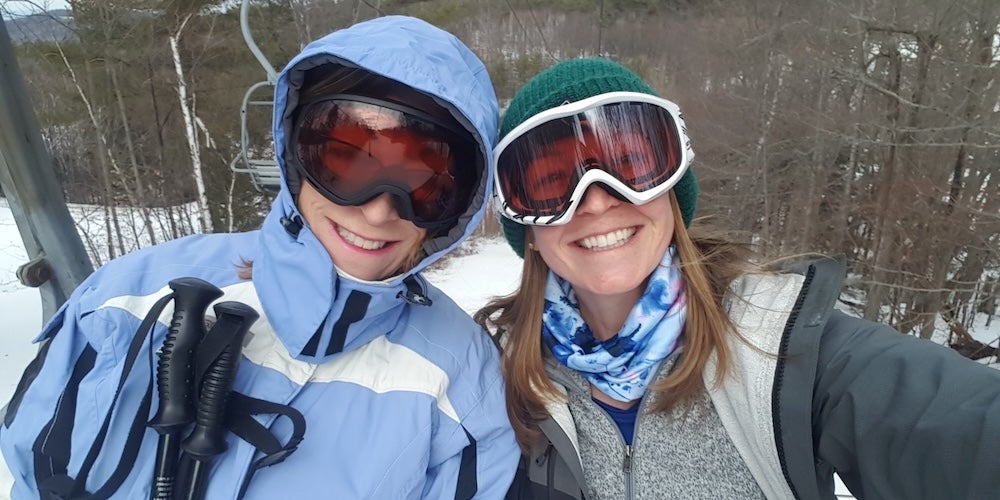
Having received treatment for the PTSD she experienced after a severe injury, Lianne is again able to enjoy traveling with her family.
For Lianne Csicsek, everything changed during a visit with her daughter in South Carolina. Lianne, who has diabetes, experienced a severe hypoglycemic seizure that caused a serious fall and required extensive surgery. Her recovery lasted seven weeks, and to this day, she does not remember the seizure, the fall, or the weeks after surgery.
What she does remember is the fear that came with it.
“I was afraid of ever feeling that way again,” Lianne said.
A mother of two now living in New Hampshire, Lianne returned home determined to focus on healing physically, emotionally, and neurologically from some defects imposed on her from the traumatic brain injury.
Finding Support at BMC
When Lianne came to BMC for follow-up care, she was dealing with ongoing anxiety and emotional stress, even as her physical injuries healed.
While she was on a waitlist for a neuropsychology evaluation, her primary care physician introduced her to a research study at BMC focused on improving access to care for people experiencing post-traumatic stress disorder (PTSD). Lianne agreed to take part in a pilot of a web-based PTSD program.
“At the time, I didn’t fully realize that what I was feeling could be PTSD,” she said. “But I knew I needed help.”
Learning Skills That Last
The online program focused on practical tools, such as breathing exercises, coping skills, and stress management techniques. Importantly, it did not require participants to describe or relive their traumatic experiences.
“The tools I took away were huge for me,” Lianne said. “Learning how to breathe through stress, let go of things I can’t change, and calm myself in the moment made a real difference.”
She also learned strategies for communicating more thoughtfully with others, like paying attention to how she was speaking to others, being more patient, and better understanding where others are coming from. These skills had a meaningful impact on her relationship with her husband, who has supported her throughout her recovery.
“We’re better at compromising now,” she said. “I have a different mindset. I’m more cautious about how I resolve disagreements, but I’m still myself. And I have skills to tell myself, ‘I can do this.’”
Over time, those skills helped Lianne regain confidence in her daily life. She recently flew on a plane by herself for the first time since the seizure and even returned to travel with her family, which felt overwhelming prior to her participation in the program.
Expanding Access to PTSD Care
Lianne’s experience reflects a larger challenge in health care. Research suggests that 70 to 85 percent of people living with PTSD never receive any treatment.
Led by clinical psychologist Sarah E. Valentine, PhD, BMC’s new research study is exploring ways to improve access to PTSD care for patients in primary care settings. Funded by the National Institute of Mental Health, the project is examining whether a stepped-care model, which coordinates primary care and specialty mental health services, can help close longstanding gaps in PTSD treatment. BMC Health System is the first to implement this sort of stepped-care model for PTSD.
The study builds on earlier pilot work conducted at BMC, including the project Lianne participated in, and reflects BMC’s broader commitment to advancing trauma-informed care through research. Based at BMC’s RESTORE Center, Dr. Valentine’s team studies innovative approaches to supporting people affected by trauma while helping expand the evidence base for PTSD treatment in health systems.
Looking Forward
For Lianne, the impact is deeply personal.
“I’m still healing,” she said. “But now I have tools, confidence, and the ability to speak up for myself. That’s something I’ll always carry with me.”