Breech Pregnancy

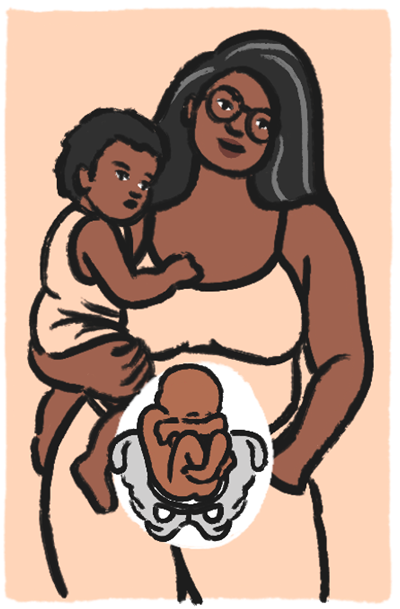
By the end of pregnancy, most babies are head-down. About three to four percent of babies will be feet- or bottom-down. This is called “breech.” If your baby is in a breech position, you have a few choices to consider.
Wait and See
Some babies turn head-down on their own before labor starts. Exams during your visits or ultrasounds will help see if your baby has turned head-down. However, if your baby stays breech, you may need a C-section later.
Benefits
- Gives your baby time to turn on their own
- No need for a procedure right away
Things to Think About
- Your baby may not turn.
- You may still need a C-section.
Turn the Baby at Home
Some self-care activities and other gentle methods can help the baby move into a head-down position.
Music
- Place a speaker low on your belly and play gentle, calm music.
- Combine this with exercises to turn your baby.
- Music is safe and calming (but may not work to turn a breech baby).
Exercises
Spinning Babies methods, or other breech exercises like “forward-leaning inversion” or “breech tilt,” may help turn your baby.
Try these exercises one or two times a day using pillows or a yoga mat.
Tutorials
Download: UNM Health Sciences Center Breech Exercises Handout
Moxibustion (Moxa)
Moxa is a form of traditional Chinese medicine that uses heat with a special “moxa stick” made of herbs near a spot on your pinky toe. When used around 34–36 weeks, moxa may help the baby turn.
Moxa can be done with an acupuncturist (Chinese medicine doctor) or at home. It has been shown to decrease the number of babies who are feet down at the time of birth.
Watch a Short Video About Moxa
Turn the Baby with a Medical Procedure
External cephalic version (ECV) is when a doctor pushes on your belly to help turn your baby head-down. It’s usually done around 37 weeks of pregnancy. ECV works about 40 to 60 percent of the time to help turn baby into a head down position.
With an ECV, you can choose to have pain medicine (epidural). Using pain medicine can help make it easier to turn your baby—in fact, the procedure is more successful if you have pain medicine.
If your ECV is successful, it is more likely you will have a vaginal birth and less likely you will need a C-section.
Benefits
- No surgery
- If successful, can make it safer to have a vaginal birth
- If successful, there's a lower chance of problems for baby (like a lower Apgar score, or needing to go to the NICU)
Things to Think About
- ECV doesn’t work for everyone.
- It can feel uncomfortable or painful.
- Sometimes it can cause bleeding or problems with the placenta.
- There is a small chance of needing an emergency C-section or inducing your labor the day of the ECV.
Planned C-Section
If your baby doesn’t turn, you can choose to give birth by C-section. Things to know about scheduled C-sections are:
- Most breech babies are born safely this way.
- They’re done around 39 weeks of pregnancy.
- An ultrasound will be done to check your baby’s position. Sometimes babies turn head-down before the C-section. If that happens you can have a vaginal birth.
Benefits
- Low chance of serious problems for baby
- Day of birth can be planned in advance
Things to Think About
- Surgery on your abdomen takes longer to heal from than vaginal birth.
- There are some risks, like infection, blood loss, or pain after the birth.
- In future pregnancies, you may be able to choose a vaginal birth, or you may need to have another C-section.
Planned Vaginal Breech Birth
Some people may want to give birth vaginally even if the baby is breech.
You can talk to a doctor about the pros and cons of a vaginal breech birth. Not all doctors are trained to do a vaginal breech birth. It may only be a safe option in certain situations. Your baby should be in the right breech position, and you must be at least 37 weeks pregnant.
Benefits
- No surgery
- For the pregnant person, lower risk of complications that can happen after having a surgery
Things to Think About
- You may need an emergency C-section during labor. Four out of 1000 people who attempt vaginal delivery with a baby in a breech position end up giving birth by C-section.
- There may be a higher risk of stillbirth:
- 0.5 out of 1000 risk with cesarean (C-section) birth vs. two out of 1000 risk with vaginal breech birth
- There is a chance of low Apgar scores and serious short term problems in the baby with vaginal breech birth.
- Your healthcare team may not be trained in vaginal breech birth.
Questions to Ask Your Healthcare Provider
- What are the chances my baby will turn on their own?
- Can I try exercises or moxa?
- Do you recommend trying to turn the baby with ECV?
- What are the risks of waiting?
- What happens if I go into labor with a breech baby?
 Medical Care