

The Grayken Center for Addiction will offer consultations to addiction researchers to suggest ways to make their research more relevant for Black people and more inclusive of Black research participants. This service is available free of charge for BMC/BU researchers. The consultations are provided by the “Lived Experience Advisory Panel” (LEAP), composed of Black people who have lived experience of problematic substance use. LEAP members are drawn from several regions of the United States (Texas, Oklahoma and Massachusetts), have a variety of professional backgrounds, bring varied perspectives to a broad range of addiction treatment and research topics and a focus on health equity for Black people. Each 60-minute consultation is moderated by a member of the Grayken team who is a clinician-researcher. During the consultation LEAP members address researchers’ questions and provide insights about how best to make addiction research more inclusive, relevant, and equitable for Black people. Researchers receive a set of written recommendations following the consultation (up to 2 weeks later). To date, we have held six consultations with BU/BMC addiction researchers and hope to make this service more widely available to addiction researchers from other institutions in the future.
Please contact Daneiris Heredia-Perez with any questions.
Set-up a consultation session with LEAP members
LEAP Consultation Life Cycle
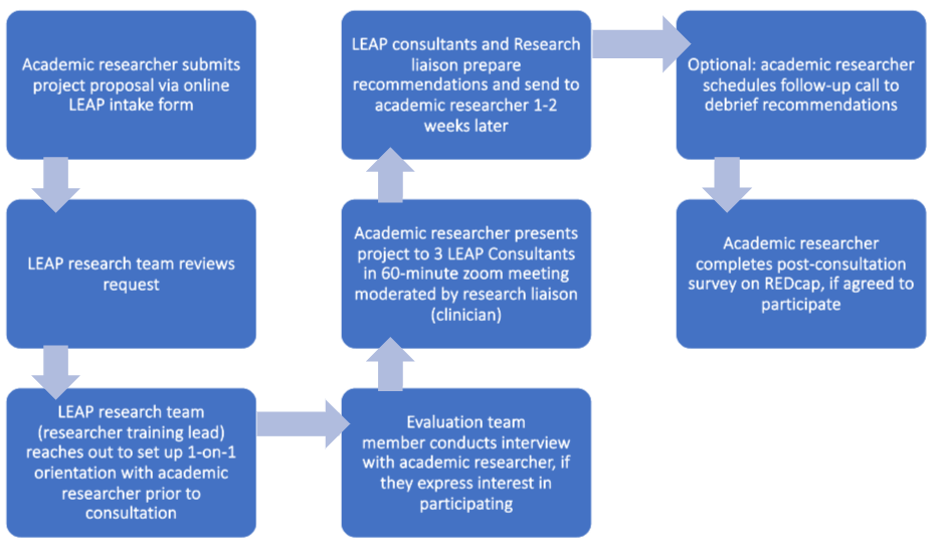
Examples of Academic Researcher questions:
- What would meaningful inclusion of community members look like to you?
- What types of mental health delivery methods do the LEAP members think may best meet the needs of people with substance use disorders, particularly people of color?
- How can we tailor the different behavioral interventions to ensure they are appealing and relevant to Black participants?
- How can we successfully recruit and retain Black participants in this research study?
- One of our interventions involves a form of contingency management - how would you describe this intervention and the science behind it to potential participants?
- What is the best way to reach out to youth with SUD to invite them to participate in our interview study and how can we make youth with SUD feel comfortable participating in the study?
- What do you recommend for including potential participants in a research co-design process? What are common mistakes that you hear about?
- What do you think of having abstinence as a goal?
- How can we help people stay on medication treatment longer?
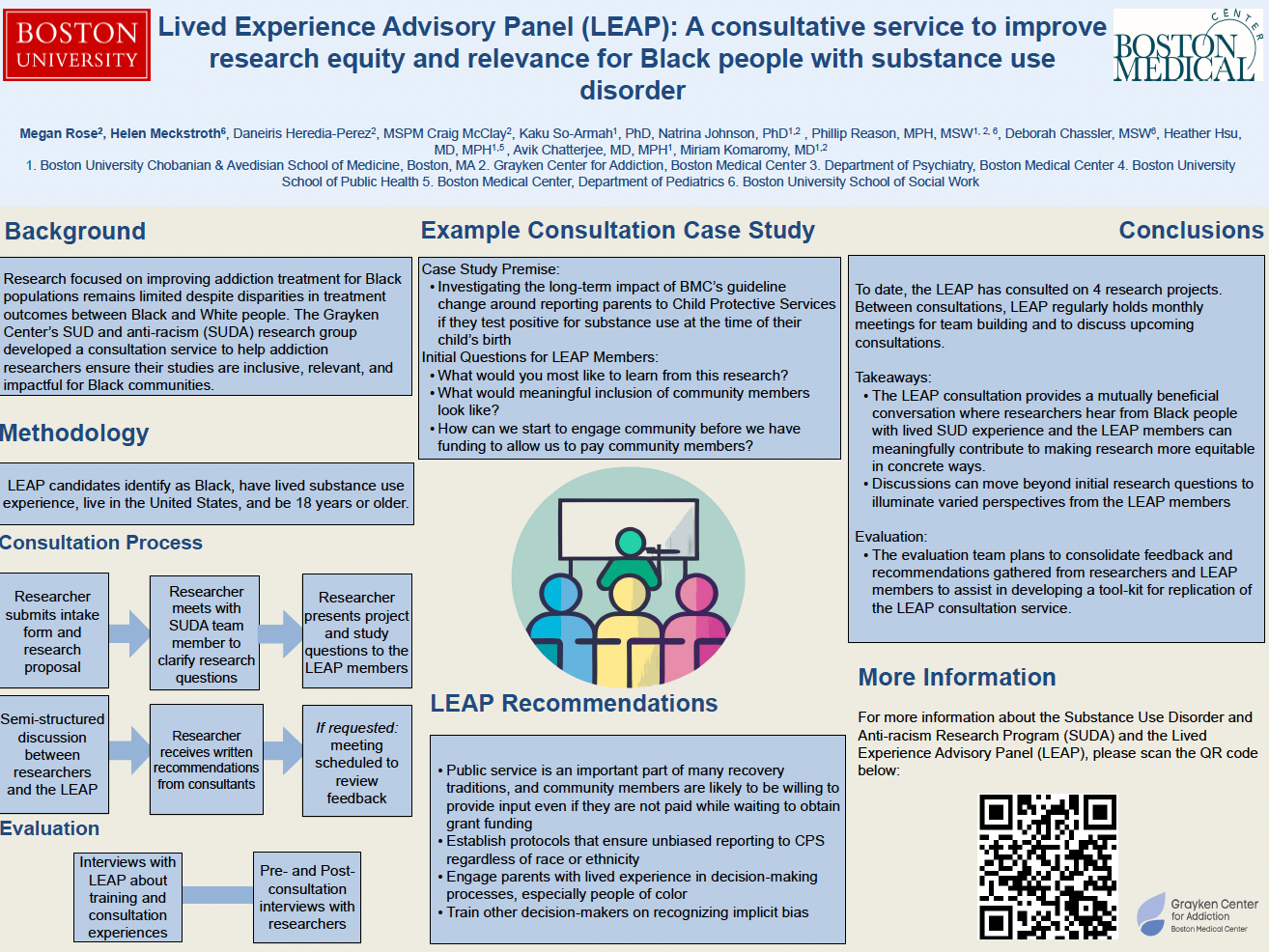
PowerPoint Presentation Examples:
Consultation Service LEAP Research Team
Miriam Komaromy, MD, FACP, DFASAM
Executive Director, Grayken Center for Addiction; LEAP Consultation Facilitator
More About Me
Miriam Komaromy, MD, FACP, DFASAM
Executive Director, Grayken Center for Addiction; LEAP Consultation Facilitator
Speaker
Dr. Miriam Komaromy is a professor of medicine at the Boston University Chobanian & Avedisian School of Medicine and a board-certified addiction medicine and internal medicine physician. She is the medical director for the Grayken Center for Addiction, where she leads the center’s work in enhancing clinical addiction treatment, education, and research on addiction, and vigorous advocacy for policy priorities that can improve the lives of people experiencing substance use disorder. She also leads an interdisciplinary group of researchers focused on how to make addiction treatment more appealing, effective, and equitable for Black patients.
Avik Chatterjee, MD, MPH
Addiction Medicine Physician, BHCHP; LEAP Consultation Facilitator
More About Me
Avik Chatterjee, MD, MPH
Addiction Medicine Physician, BHCHP; LEAP Consultation Facilitator
Lead - Breakout Session: Experiences of people with SUD in low-barrier housing
Dr. Avik Chatterjee is a primary care and addiction medicine physician at several shelter-based clinics through Boston Health Care for the Homeless Program. His areas of clinical and research interest include innovative treatment models for opioid use disorder in marginalized populations and interventions on social determinants of health, such as food insecurity.
Dr. Chatterjee has an additional interest in racism and health care, particularly its manifestations in medical education and training. He is an assistant professor of medicine at the Boston University Chobanian & Avedisian School of Medicine.
Daneiris Heredia-Perez, MSPM
Senior Research Manager, Grayken Center for Addiction
More About Me
Daneiris Heredia-Perez, MSPM
Senior Research Manager, Grayken Center for Addiction
Daneiris Heredia-Perez, MSPM, is a senior research manager for the Grayken Center of Addiction. As an advocate for wellness and health, she is passionate about lifting the voices of those often sidelined, thus researching ways to develop equitable care for Black patients struggling with substance use and children with parents struggling with substance use. Daneiris takes great interest in working alongside patients, thus has been committed to collaborating with patients on research efforts
Deborah Chassler, MSW
Senior Academic Researcher; LEAP Consultation Training Lead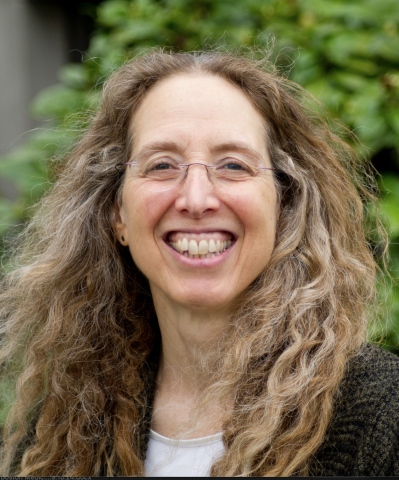
More About Me
Deborah Chassler, MSW
Senior Academic Researcher; LEAP Consultation Training Lead
Deborah Chassler, MSW is a senior academic researcher based at Boston University School of Social Work (BUSSW). She is deeply committed to social work values of equity and justice. In practice that means she grounds her work in community engagement, harm reduction, and knowledge democracy to address racial and health equity. As a researcher she is currently a member of Grayken Center for Addiction research team, and she also works with the HEALing Communities Study at BMC. At BUSSW she mentors doctoral students and for many years she taught in the masters’ program. For two years she was the Faculty Fellow for BU Diversity and Inclusion. She currently serves on the National Advisory Council for Drug Abuse.
Kaku So-Armah, PhD
Clinical Researcher, Boston University; LEAP Consultation Service Evaluator
More About Me
Kaku So-Armah, PhD
Clinical Researcher, Boston University; LEAP Consultation Service Evaluator
Speaker - Plenary Presentation 1: How Can We Make Addiction Treatment More Appealing, Effective and Equitable for Black Patients?
Natrina Johnson, PhD
Research Scientist, Grayken Center for Addiction
More About Me
Natrina Johnson, PhD
Research Scientist, Grayken Center for Addiction
Natrina Johnson, PhD, is a health services researcher whose interests include disparities in treatment access and health outcomes for people with co-occurring psychiatric and substance use disorders. Dr. Johnson has prior experience working as a substance use counselor and as a house manager in transitional treatment programs for adults in recovery. Her research integrates qualitative and quantitative research methods to inform policy and practice. She joined the Grayken Center in August 2023 to work with the Substance Use Disorder Antiracism “SUDA” workgroup and will help lead the analysis of qualitative data gathered from multidisciplinary experts in addiction treatment
Craig McClay
Community Engagement Specialist, BMC; LEAP Engagement Specialist and LEAP Member Training Support
More About Me
Craig McClay
Community Engagement Specialist, BMC; LEAP Engagement Specialist and LEAP Member Training Support
Speaker - Plenary Presentation 1: How Can We Make Addiction Treatment More Appealing, Effective and Equitable for Black Patients?
Craig McClay is a facilitator and engagement specialist with more than three decades of experience working with diverse communities. McClay is devoted to designing interactive meeting experiences that help individuals heal and restore communities in places that have endured systemic harms. His work builds on diversity, equity, inclusion, vitality, and restorative justice. Currently, McClay works as the community engagement facilitation specialist with the HEALing Communities Study and with the substance use disorder and anti-racism team at the Grayken Center for Addiction.
Jack Kloster, MS
Research Intern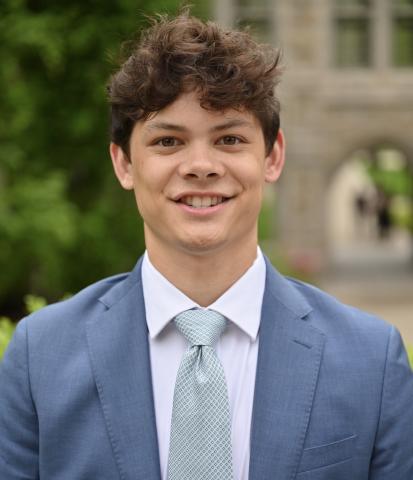
More About Me
Jack Kloster, MS
Research Intern
Jack Kloster, MS, is a research intern with the Grayken Center for Addiction at Boston Medical Center. He earned his Master’s in Bioethics from Harvard Medical School and has a background in substance use research, including his senior thesis at Boston College examining strategies to address the opioid crisis and improve homeless healthcare in Boston. In addition to his research role, Jack serves as a case manager at the Southampton Street Shelter with Boston Health Care for the Homeless. His work centers on advancing ethics in healthcare, reducing barriers to access, and promoting patient-centered care.