


Doctors weren’t sure he’d survive. Thirty years later, Joe still returns to thank the care team who never stopped believing in him.
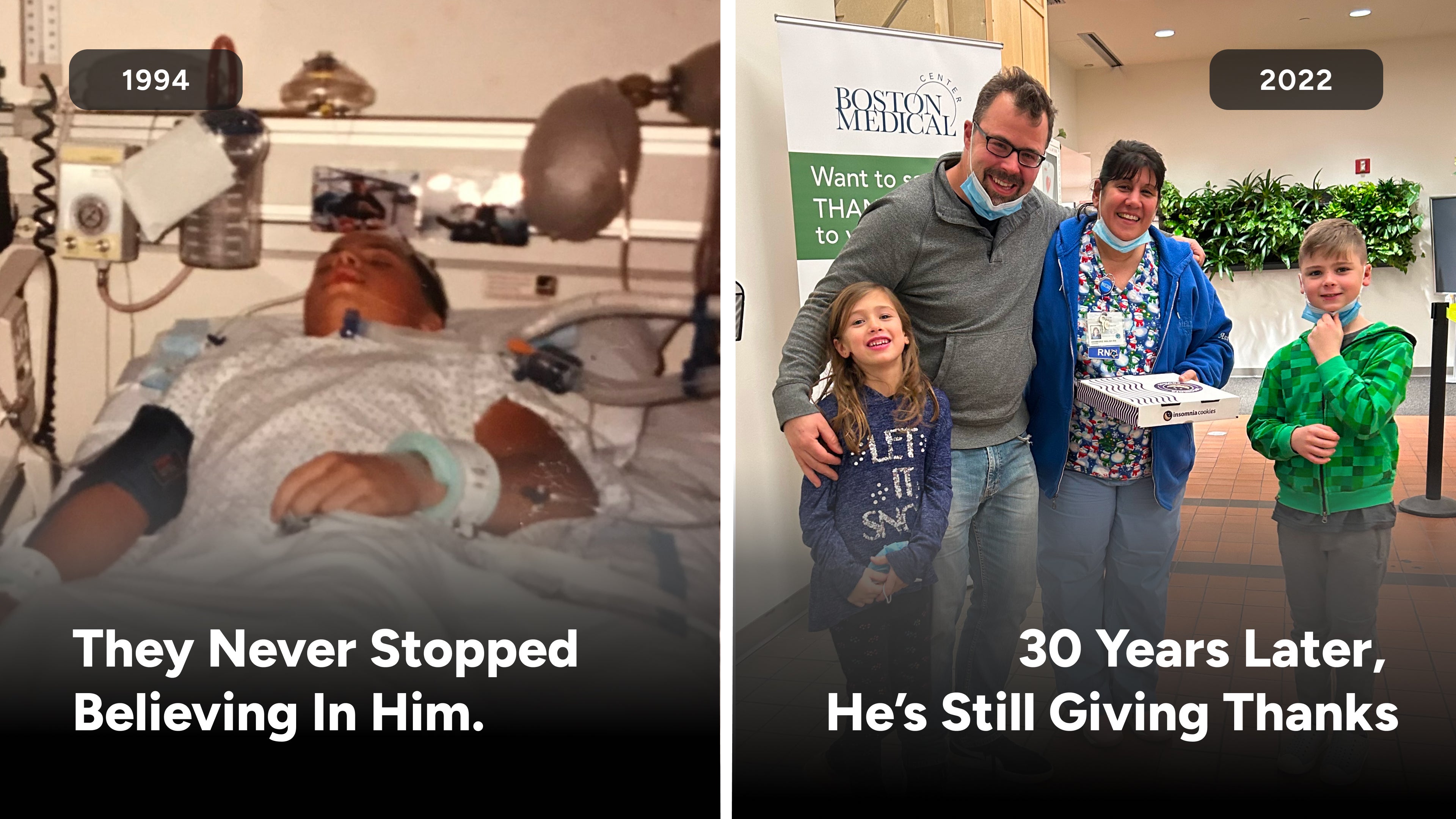
On December 23, 2022, Joe Tierney walked into the lobby of Boston Medical Center with his two children beside him and freshly baked cookies tucked under his arm. “I have kind of a weird question,” he remembers saying to the front desk attendant. “I was a patient here about 30 years ago, and I have cookies for the nurses in the SICU. Is there a way I could give these to them?”
Much had changed over the years, including the hospital’s name, but Joe never forgot the doctors, nurses, and caregivers who had saved his life.
This wasn’t Joe’s first visit back to BMC. Over the years, he and his family had returned to thank the care team. However, this visit was different. For the first time, he brought his children with him, hoping to introduce them to the people who had helped shape the life he would go on to build.
A Summer That Changed Everything
In the summer of 1994, 15-year-old Joe Tierney was living in Hyde Park and working his first summer job for a local property management company. During his third week on the job, he was helping a tenant move out of an apartment building a few blocks from his house.
“Any other day, I would have been given a ride, but I said, ‘I’ll walk home, guys,’” Joe recalls. “As I was leaving, through a combination of weather and negligence, I got hit by a car right in front of the complex on Truman Parkway.”
Neighbors rushed to help. A family friend, who happened to be out for a jog, found Joe unconscious in the street, called an ambulance, and alerted Joe’s father, who came running from their nearby home.
Recognizing the severity of his injuries, the paramedics rushed Joe and his father to Boston City Hospital—one of the two hospitals that would later merge to become Boston Medical Center.
“Hands down, the best trauma unit in the country,” Joe says, recalling the story he was later told. “That’s where we’re going to go. That’s where he’ll receive the best care.”
Facing an Uncertain Future
Joe was still unconscious. His ribs and skull were fractured, and he had a severe hematoma that was putting dangerous pressure on his brain. The prognosis, Joe says, was “quite grim.”
Emergency surgery relieved the immediate pressure on his brain, but his condition remained critical. To give his body the best chance to heal, doctors placed him in a medically induced coma.
What came next was uncertain. Doctors didn’t know if he would wake up or, if he did, what his recovery might look like. While they believed he could physically recover, there were serious concerns about the lasting effects of his brain injury.
“I turned 16 while I was asleep,” Joe chuckles. “They had a birthday cake for me. My father took some frosting and wiped it across my lips. Within about two minutes, I threw up. That was my one response.”
The Legacy of “Dr. Hope”
After nearly two weeks in a medically induced coma, Joe’s physicians felt it was finally safe to wean him off the medication.
But Joe still wouldn’t wake up.
Despite the expert care and the unwavering support of his family and friends, the reality of the situation was beginning to settle in. Joe’s parents, exhausted and heartbroken, wondered what would come next.
Then one physician stopped them in the hallway. The Tierneys don’t remember his name, but they have never forgotten what he said. To them, he will always be known as “Dr. Hope.”
“
Don’t ever let anyone or anything take away hope. You’ll always need that. You’ll always carry that. You guys have it. It’s beautiful. Don’t lose it.
"Dr. Hope"
Those words became a lifeline for the family, carrying them through the darkest days until the moment they had been praying for finally arrived.
On July 30, 1994, Joe Tierney opened his eyes. He didn’t remember arriving at the hospital or why he was there. He had no idea that he had spent nearly two weeks in a coma. As he tried to piece together his surroundings, Joe saw his father sitting beside him.
The first thing he remembers trying to say was what he wanted most: “Home. I want to go home.”
The Community That Got Joe Home
Going home became the goal, but there was still a great deal of recovery ahead. After leaving the surgical intensive care unit (SICU), Joe was transferred to the pediatric inpatient unit (PICU), where nurses managed his day-to-day.
“The doctors are behind the scenes; the nurses are on the front lines,” Joe says. “They really made an impossible experience quite manageable for my family. They always had music playing for me.”
Joe had a tracheostomy placed, which meant he could not talk, so he communicated by writing notes, requesting songs and cracking jokes, and finding ways to bring moments of normalcy to each day. Even in the most difficult moments, Joe says, no one at the hospital made him feel like a full recovery or a return to regular life was out of reach.
“
“I was never given a reason to not believe. From the dietitian to the nurses to the doctors, they never gave me a reason to believe that I wasn’t going to be fine.
Joe Tierney
That belief extended beyond the hospital room. As Joe recovered, family, friends, neighbors, and the wider Boston community rallied around him. His local parish held a Mass and prayer service for him attended by more than 400 people. Visitors came in and out of his hospital room, sometimes ten at a time, bringing cards, food, and encouragement for Joe and his family.
One unexpected visitor left a lasting impression.
In 1994, the New York Rangers had just won the Stanley Cup. Brian Noonan, a member of that team and a South Boston native, learned about Joe through a connection to his family and surprised him with a visit—the Stanley Cup in hand.
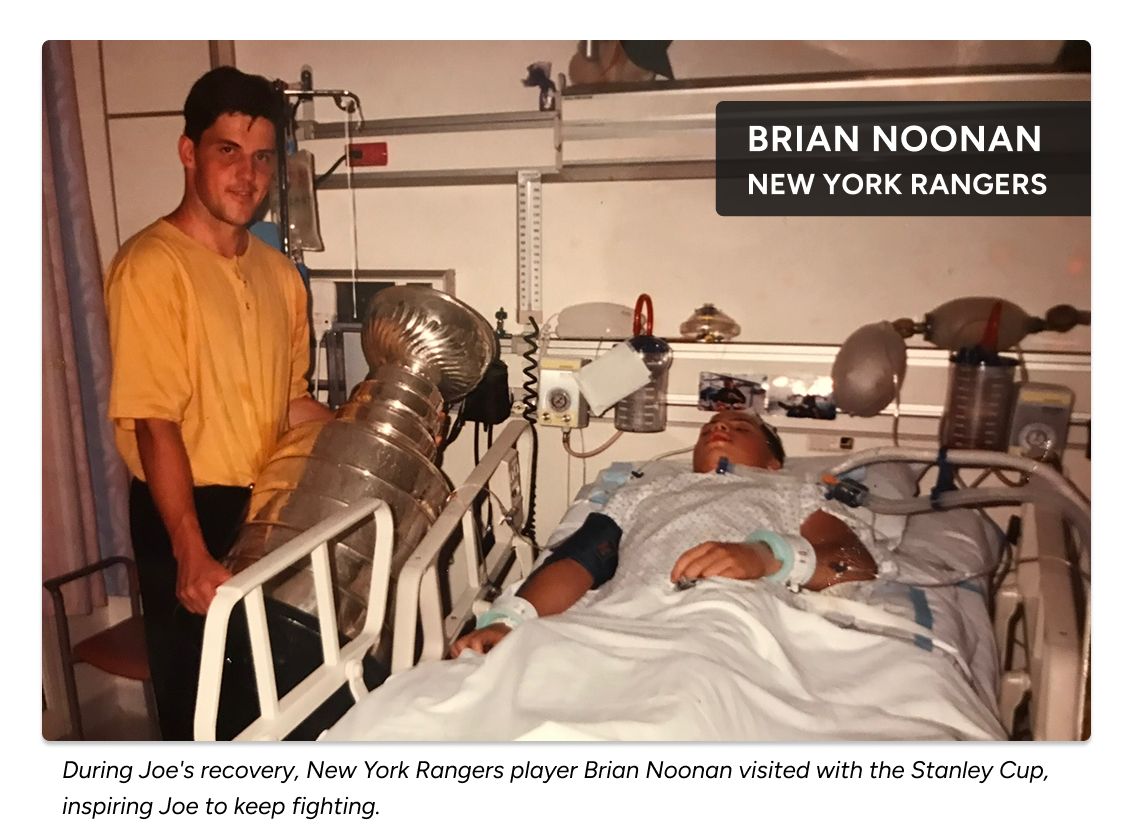
Even as a Boston Bruins fan, Joe never forgot the moment. What stayed with him the most was what happened later that summer.
“He came to visit with the Stanley Cup, which was amazing,” Joe says. “But the fact that he came back was unheard of.”
That second visit helped Joe see his progress in a new way, giving him even more motivation to keep pushing forward.
A Life Reclaimed
On September 2, 1994, Joe was finally discharged from the hospital. After nearly seven weeks— his entire summer—he was ready for the next step.
“I went right back to school,” Joe says. “I started with a part-time schedule, so I took three instead of six classes, but I got back on track.”
That became Joe’s approach to recovery.
“I just dove right into it,” he says. “There was no time to stop and think, ‘Oh, what about this? What about that?’ I was like, no, I have to get better. I have to jump right back into this.”
The first step was getting back to school. Despite the early concerns about his cognitive recovery, Joe graduated from high school on time, earned his college degree, attended law school, and became a practicing attorney.
That same determination stayed with him long after his initial recovery. Joe continued to challenge himself physically and would go on to complete the Pan-Mass Challenge not once, but twice, and doing the same with the Boston Marathon.
“
Everyone says, ‘Wow, Joe, you’re so driven,’ But I wasn’t like this before the accident. Something happened in that hospital building that completely changed me.
Joe Tierney
At first, the goal was simple: get home. But in the years that followed, Joe kept pushing further, turning recovery into a life that went beyond what once felt possible.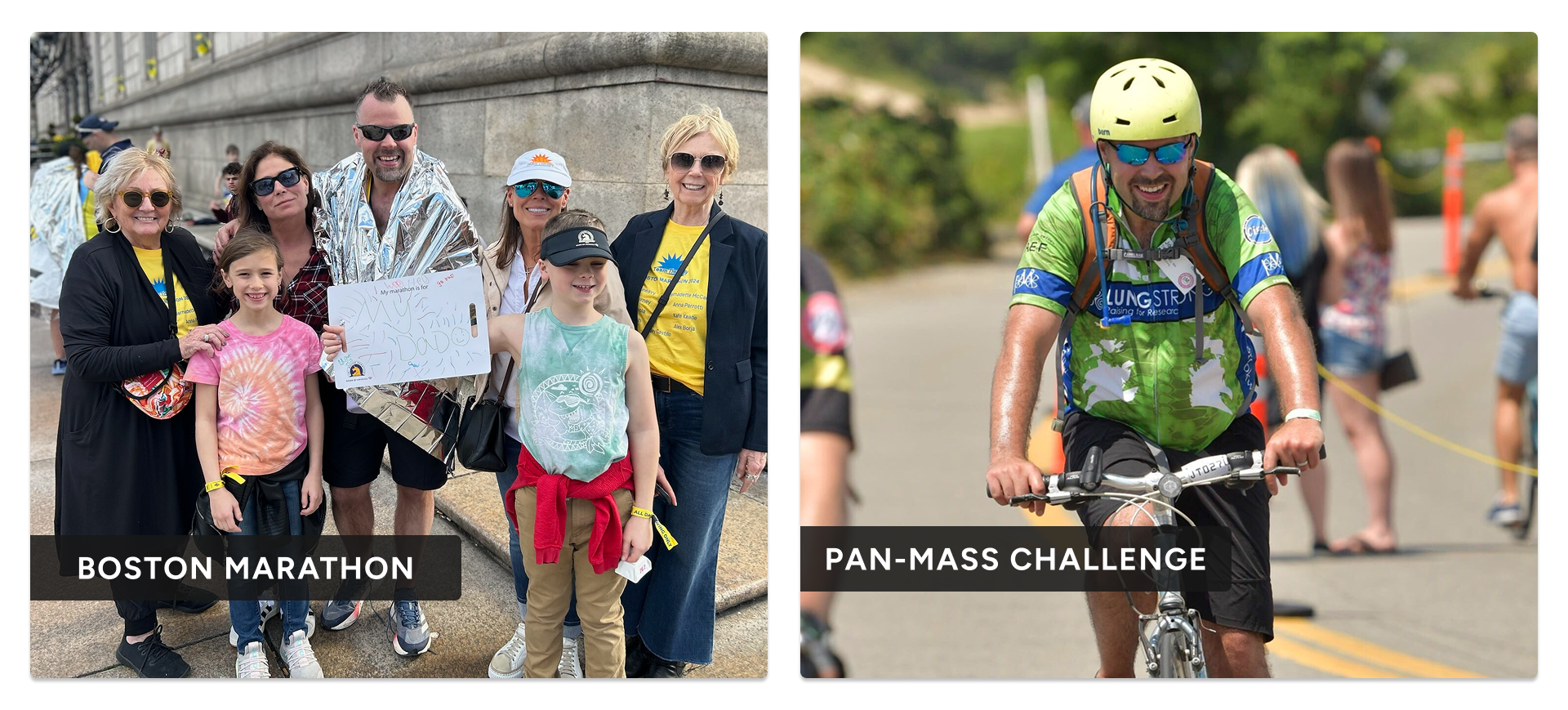
Keeping Up the Tradition
Three months after returning home, Joe and his family started a new tradition. Every Thanksgiving, they returned to the SICU, PICU, and pediatric inpatient unit, the three areas where Joe had been cared for, with baskets filled with cakes, fruit, and other treats.
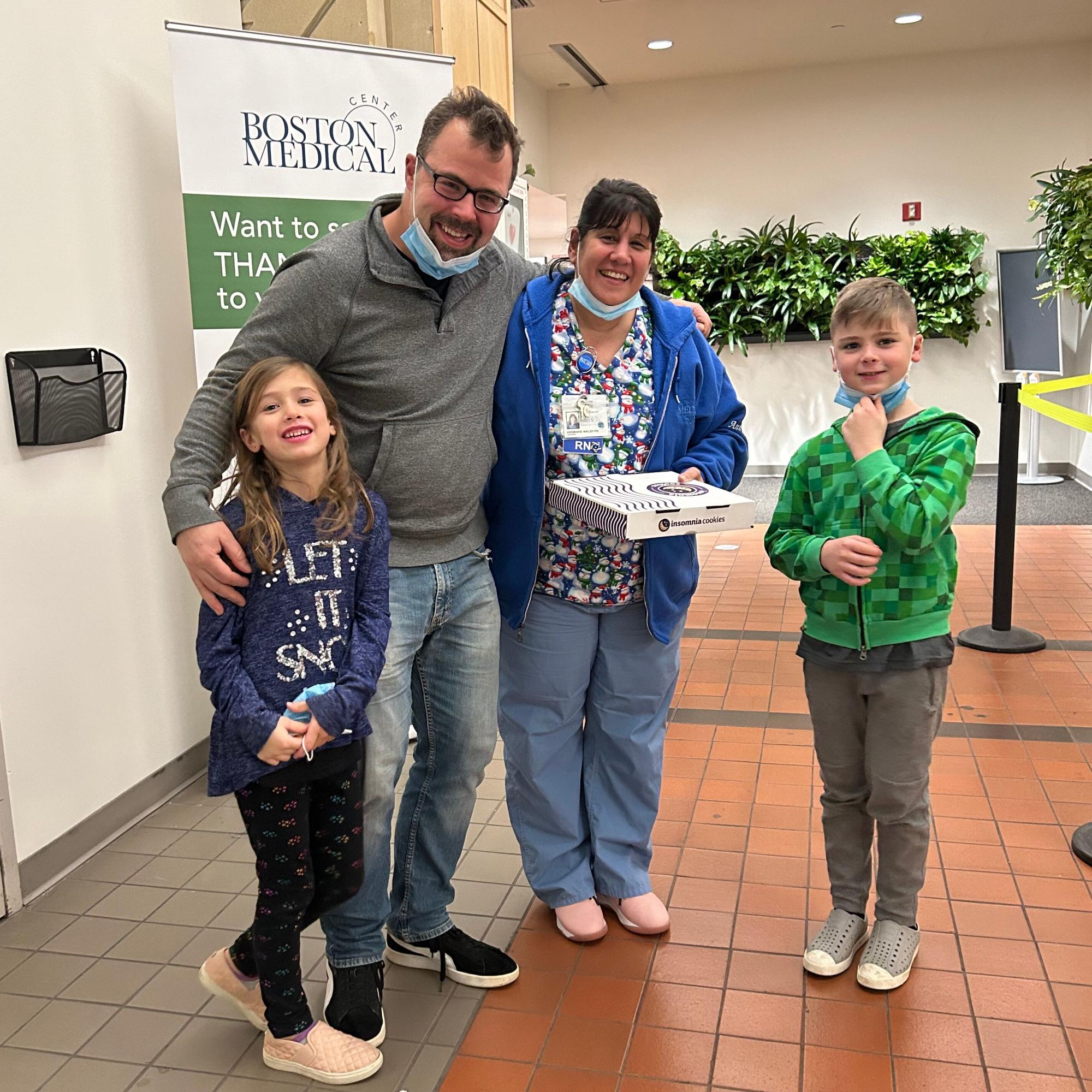
Since 1994, Joe’s family has regularly brought treats to the BMC nursing staff to express their gratitude for the lifesaving care he received.
“My parents had a very strong connection to the nurses,” Joe says. “It started as a Thanksgiving tradition, but we’d also drop off cakes around Christmas Eve.”
As Joe got older and life moved forward, the visits became less frequent. But in 2022, standing in the lobby of BMC with his two children, Joe was continuing that tradition.
When a nurse from the unit arrived, Joe began explaining who he was and why he had come back. Then the connection became clear.
“You’re Joe Tierney. I took care of you,” she said.
It was AnnMarie Walsh, one of the nurses who had cared for him during his hospital stay. Nearly 30 years later, she still remembered him and his family.
Looking back on the life he has built since that summer, Joe is clear about what made the difference.
“
My family was amazing. My community was amazing. But if you take the culture of Boston Medical Center out of it, I’m not who I am today.
Joe Tierney
As Boston Medical Center celebrates its 30th year as BMC, Joe’s story is a reminder that the impact of compassionate care extends far beyond a hospital stay. Sometimes, that care becomes the foundation of a relationship that lasts a lifetime.