


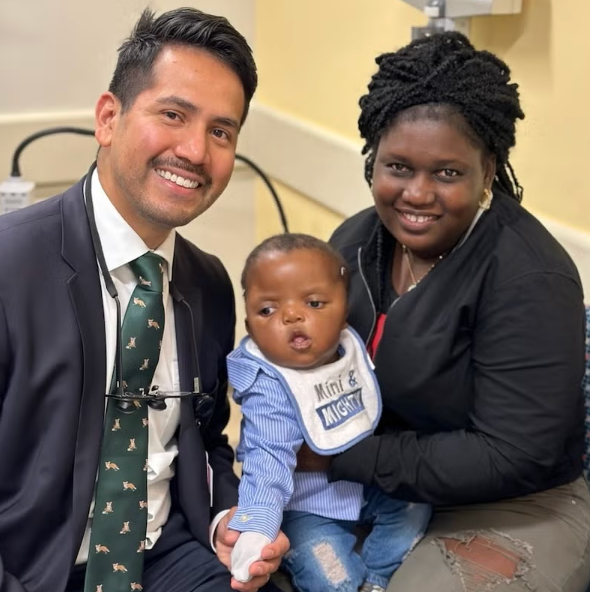
Becoming a parent is enough of a challenge. For Marilande Pierre, motherhood began with additional, unexpected hurdles: just moments after her son Michel was born, she learned he would need reconstructive surgery.
Marilande was living in Salisbury, Maryland, when she became pregnant. Once she learned there were concerns about her baby’s development, she began traveling to a hospital in Washington, D.C., for care.
“It was a shock. When I was pregnant, they told me that his hands and his feet are not well,” she recalls. “But they never told me about his head. When he was born, I found out he had something called Apert.”
Apert syndrome is a rare genetic condition that causes bones in a baby’s skull to fuse too early, deforming the face and skull (a condition called craniosynostosis), as well as causing other anomalies of fingers and toes (called syndactyly). Without surgery on the head, the condition can lead to serious complications, including increased pressure on the brain and severe facial deformities.
After Michel’s birth, he was fitted with a medical device to support his breathing. But accessing consistent care proved difficult. The hospital often scheduled Marilande with morning appointments even though she was only available in the afternoons, and traveling from Salisbury to Washington was a five-hour round trip.
Eventually, Marilande relocated to Boston in search of more reliable care. When Michel’s machine malfunctioned, she rushed him to the Emergency Department at Boston Medical Center. There, staff connected her with specialists and introduced her to craniofacial plastic surgeon Dr. Jorge Lujan.
Boston Medical Center’s Team-Based Approach
Dr. Lujan spearheads a multidisciplinary pediatric craniofacial team at BMC that includes pediatric neurosurgeon Dr. James Holsapple, pediatric otolaryngologists Drs. Andrew Scott and Mark Vecchiotti, maxillofacial surgeon Dr. Radhika Chigurupati, and other specialists from the Pediatric Anesthesia and Pediatric Critical Care departments.
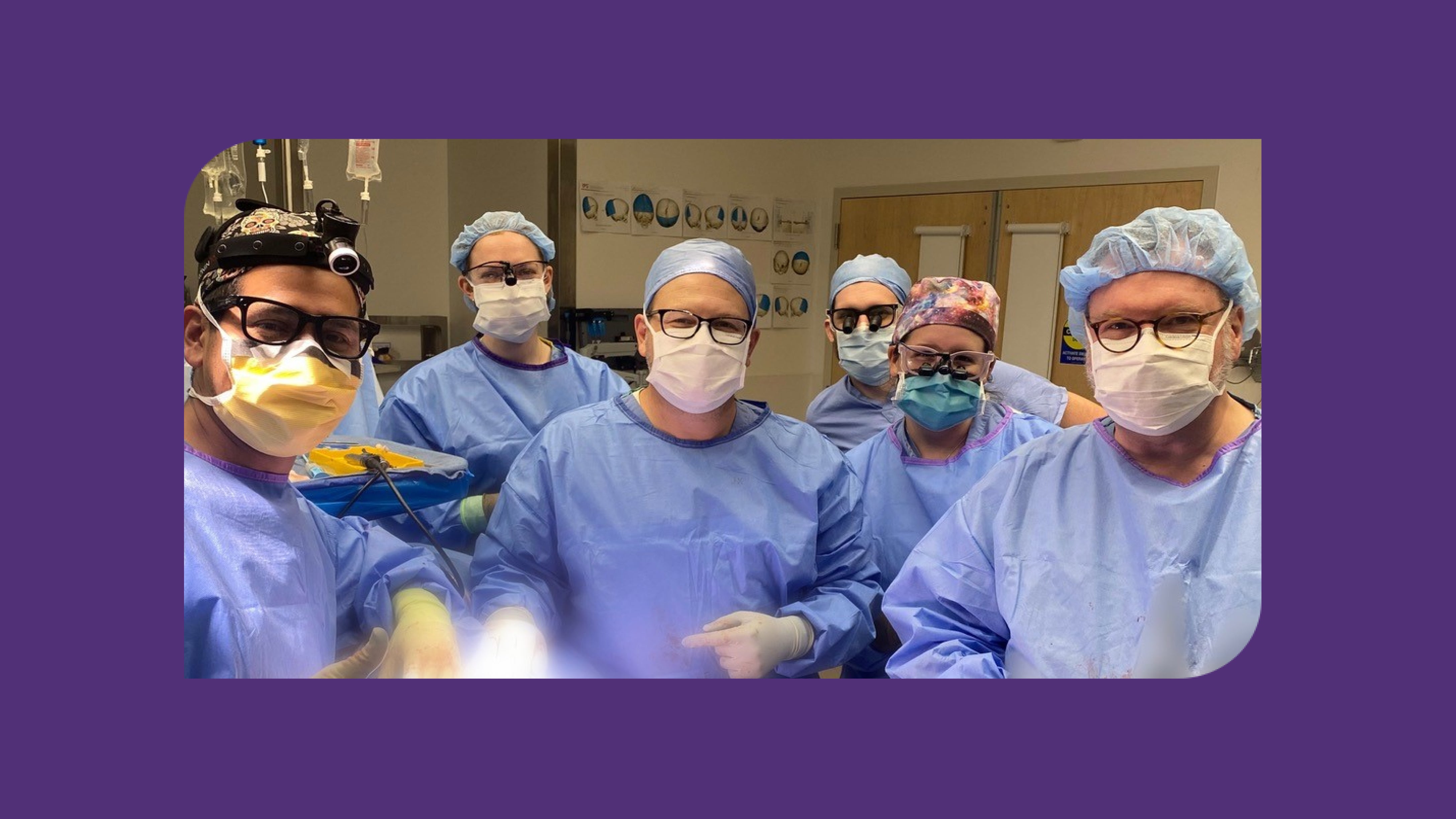
Prior to this team’s formation, patients with rare skull anomalies, such as craniosynostosis, would automatically be referred to other hospitals. Now, with this collaboration, patients can receive comprehensive treatment at BMC.
“Many of these kids, like Michel, have syndromes that need multidisciplinary care,” explains Dr. Scott. “What’s exciting is that all those services exist at BMC. We use our own endocrinologists, orthodontists—everyone’s already part of BMC. If one surgeon isn’t available for a follow-up, another who knows the case can step in.” This coordinated approach would prove to be critical in Michel’s road to recovery.
During the emergency room visit, Michel’s malfunctioning equipment was fixed, and Dr. Lujan discovered that Michel’s Apert syndrome was creating a far more serious functional issue. “When I saw Dr. Lujan, he said the front of his face was developed, but the back of his head wasn’t developing appropriately. He needed surgery to allow his brain to grow,” said Marilande.
Every Procedure Is Case-by-Case
“No two patients are the same,” says Dr. Lujan. “Even if the diagnosis is similar—say, craniosynostosis—it’s still case by case.” In Michel’s case, treatment required an advanced technique known as Posterior Vault Distraction Osteogenesis, in which a metal rod extends through the skin to gradually expand the back of the head and create new bone. Marilande had to turn the adjustment knob several times a day and carefully keep the area clean.
“They put a screw in, and I used to turn it all the time. Two to three times daily. In the second surgery, they took the screw out and reshaped the front of his face.” Asked what she remembers most about that time, Marilande pauses. “Sadness,” she says quietly. There isn’t much more that can be said. Marilande knew her son was getting the best possible care. She felt like she was part of the process each step of the way, but the emotions were, and still are, difficult. “Dr. Lujan is very good,” Marilande continues. “Everybody at BMC has been very helpful. I’ve seen a huge difference in Michel because of them.”
Moving Forward Each Day
Since his initial surgery, Michel, still just a year and a half old, has undergone two additional procedures—another to reshape his forehead and roof of the eyes, and one to separate his fused fingers. In the future, he will require additional hand surgeries as he continues to grow.
Through ongoing monitoring and scheduled interventions, Michel’s team will continue managing his condition, supporting his development, and helping him follow his treatment plan. Each day brings a new challenge to Marilande and Michel, but with the ongoing support from Michel’s care team, they won’t be alone as they navigate the road ahead. “I know what we’re going through is not easy,” Marilande says. “We just take each day as it is and live our lives like that.”