
Boston Medical Center Health System (BMCHS) seeks to establish long-term cooperative business relationships with manufacturers and other vendors who maintain excellence in quality and provide competitive pricing.
Manufacturer and vendor representatives must have prior appointments for all engagements at Boston Medical Center locations. The actions and behavior of vendor representatives must be consistent with BMCHS policies and the Code of Conduct. For more information, contact:
Supply Chain Operations
960 Massachusetts Avenue, 2nd Floor
Boston, MA 02118
617.638.6080

Vendor Registration and Compliance
Vendors that are interested in conducting business with Boston Medical Center must register with Symplyr (formerly SEC3URE/Reptrax). All vendors onsite at BMC Health System facilities without an appointment and not registered through Symplyr will be asked to leave.
Vendor representatives may access Symplyr at one of the following locations:
Boston Medical Center (Menino Building)
840 Harrison Avenue, Main Lobby
Boston, MA 02118
Boston Medical Center – Brighton
736 Cambridge Street, Main Lobby
Brighton, MA 02135
Boston Medical Center – South
235 North Pearl Street, Main Lobby
Brockton, MA 02301
BMC Behavioral Health Center
34 North Pearl Street
Brockton, MA 02301
Vendor Access Topics
Sustainable Procurement
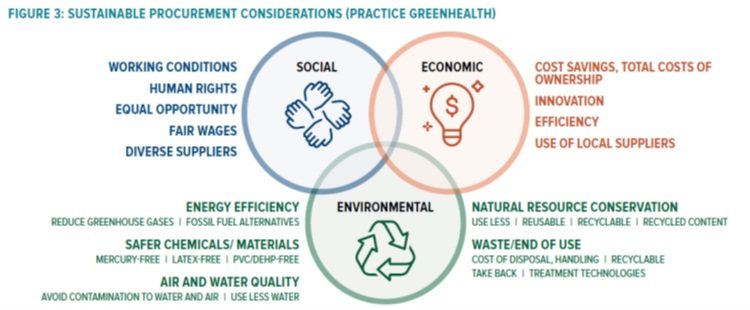
What we buy-and how we buy it-makes an impact. Procurement has significant implications for patient care, the environment, worker rights and safety, and human health. Products that have a lesser or reduced adverse effect on public health, workforce safety, and the environment should be prioritized over similar competing products or services that serve the same purpose.
We integrate sustainable procurement practices throughout the life cycle of products and services to select safer and healthier products and services that are also environmentally sound. We have developed a defined roadmap to enable our collaboration with suppliers, GPOs, industry groups, and peers to leverage the industry's collective purchasing power and increase the availability of more sustainable products.
Sustainable Procurement Guidelines at BMC
The purpose of our guidelines document is to establish BMC Health System's procurement guidelines regarding the health and environmental impacts of products and services when making purchasing decisions without compromising performance or affordability. These guidelines:
- Prioritize products that minimize or eliminate chemicals of concern in finished products and in the manufacture, process, use, and disposal of those products; and release little or no toxic byproducts across their lifecycle;
- Prioritize products that minimize the generation of waste over the lifecycle of the product; and
- Consider the greenhouse gas emissions impact of individual products, when appropriate, as well as the greenhouse gas reduction commitments and actions of distributors, manufacturers, and suppliers.
Download the BMCHS Sustainable Procurement Guidelines (PDF)
Please note: the canonical version of these guidelines can be found on the BMC employee intranet. There may be a slight delay in updating the public link above when revisions are published. Please contact Supply Chain Operations if you have questions.
High-Impact Categories and Collaboratives
- CHARME: BMC Health System is a contributing member to the Collaborative for Healthcare Action to Reduce MedTech Emissions (CHARME). Under the initiative, health systems, medical device and equipment suppliers, distributors, GPOs, and other key industry stakeholders collaborate to define, implement, and champion best practices to reduce emissions from the medical technology supply chain.
- Green Cleaning: In 2022, BMC began a switch to a nontoxic hypochlorous acid surface cleaner that is safer, more effective, and more environmentally friendly. In 2023, 94 percent of cleaning products in targeted categories used at BMC were certified green cleaners, reducing the use of harsh chemicals to protect the health of our staff.
- Healthy Interiors: BMC achieved a 69 percent Healthier Interiors spend in 2023, with around $2.2 million spent on furnishings and furniture that eliminate targeted chemicals and materials of concern, including: formaldehyde/VOCs, perfluorinated compounds, PVC, antimicrobials, and flame retardants.
- EPEAT® Electronics: BMC Health System predominantly purchases Electronic Product Environmental Assessment Tool (EPEAT®)–rated computers, monitors, laptops, televisions, and mobile phones. In 2023, BMC purchased over $1.6 million of EPEAT®-registered devices, thereby limiting impacts through each product’s lifecycle, reducing energy, and increasing the use of recycled plastic.
- Local and Sustainable Food: Through two farms covering nearly 8,000 square feet, the BMC Rooftop Farm strengthens at-risk local food systems, reduces our carbon footprint, and increases green space. The farms also support our innovative clinical program, the Preventive Food Pantry, where physicians “prescribe” supplemental foods that facilitate health and recovery for many clinical diagnoses, including cancer, heart disease, and HIV/AIDS.