Boston Medical Center is driving the future of health equity through initiatives that address the root causes of health disparities. The Health Equity Accelerator at Boston Medical Center is working to transform healthcare systems to eliminate gaps in life expectancy and quality of life across racial and ethnic groups. The initiative currently focuses on five clinical areas where significant disparities persist.
BMC Nourishing Our Community aligns with BMC’s broader commitment to health equity by ensuring that programs and initiatives are grounded in strategic alignment, community engagement, and continuous quality improvement evaluation.
Alignment
Food Security
Nearly 19% of adult Boston residents reported that, within the last 12 months, the food they bought did not last and they did not have money to get more (Boston Behavioral Risk Factor Surveillance System, 2019, 2021, and 2023 combined).
Nutrition
Approximately half of Boston Public School (BPS) high school students reported they do not eat vegetables at least once per day and almost half reported they do not eat fruit or drink 100% fruit juice at least once per day (Youth Risk Behavior Survey, 2019, 2021, and 2023 combined data).
Physical Activity
In 2023, 37.2% of Boston youth reported engaging in regular physical activity, defined as at least 60 minutes per day on five or more of the preceding seven days. This represents a more than 25% increase from 2017 when only 29.6% of youth reported engaging in regular physical activity (Centers for Disease Control and Prevention and Boston Public Schools, Youth Risk Behavior Survey, 2017-2023).
Community Engagement
Community engagement is central to the development and implementation of Nourishing Our Community initiatives. BMC collaborates closely with patients, community organizations, local food producers, and residents to ensure programs reflect community priorities, cultural preferences, and lived experiences. This collaborative approach helps build trust, strengthen participation, and create sustainable solutions that improve food access and health equity. All programs are designed to address the Annual Community Health Needs assessment.

Quality Improvement
Continuous quality improvement and evaluation are integrated into all Nourishing Our Community programs to ensure initiatives are effective, responsive, and aligned with community needs. BMC uses data-informed strategies, participant feedback, and measurable outcomes to assess program impact and identify opportunities for growth and innovation. Evaluation efforts focus on improving food access, patient and community experience, operational effectiveness, and health outcomes while ensuring programs remain equitable, culturally responsive, and community-centered. Findings are used to strengthen existing initiatives, guide future planning, and support long-term sustainability.
Health Equity Report
Nourishing Our Community Featured in Heal Equity Accelerator Year in Review
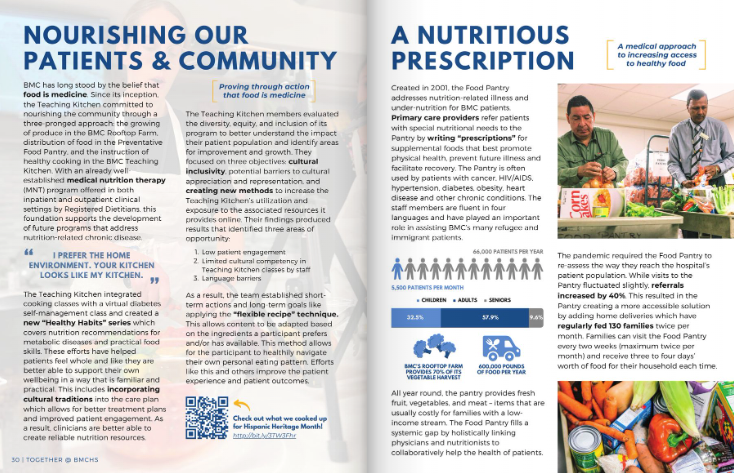
The Teaching Kitchen was featured in the Health Equity Accelerator's Year in Review which highlighted the work of the teaching kitchen feature and other Nourishing Our Community programs. Read about them in the Year in Review Book.