
A Message From The Program Director
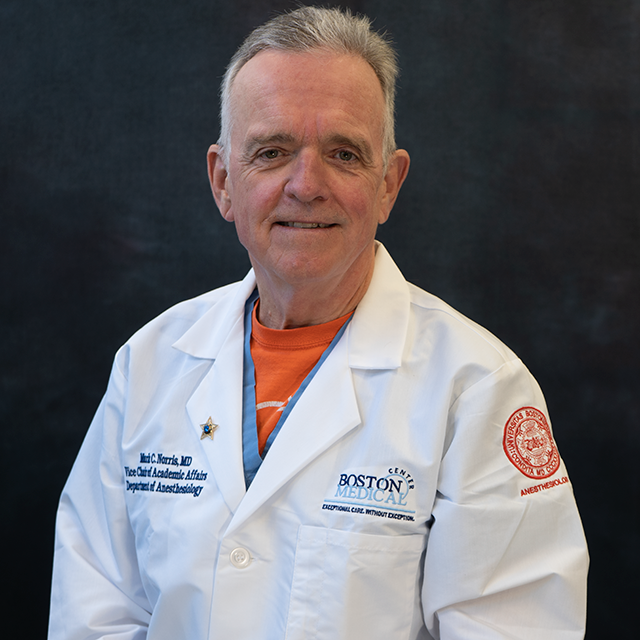
Welcome to the Boston Medical Center Anesthesia Residency Program. At BMC, we train residents to become outstanding clinical anesthesiologists who provide exceptional care without exception to patients from all walks of life from all around the world. Because BMC is the largest safety net hospital in New England, our residents learn first-hand about the complex relationships among race, gender, socioeconomic status and health. This environment allows us to offer one of the most comprehensive anesthesiology training programs in the country. Our graduates are well equipped to provide complete perioperative care for healthy or sick patients of all ages for any type of surgical or invasive procedure. Our residency also provides a solid foundation for those who plan to pursue advanced training. Follow the link below to learn more about Anesthesiology training at BMC.
– Mark Norris, M.D.
To learn more about the program, contact Elizabeth Colston, residency coordinator, at 617-638-6975 or Elizabeth.Colston@bmc.org, or follow this link to read more information
Our Mission
Our goal is to provide an Anesthesiology Residency Training Program which provides individual growth opportunities, teaches clinical competency, and fosters administrative, research, and mentoring skills. We encourage residents to understand and develop their own learning styles and we guide residents as they establish strong foundations upon which to build their future practice. We use the strengths and motivations of adult learners to encourage development of lifelong habits encompassing the ACGME’s six core competencies.
The philosophy of the Boston Medical Center’s Anesthesiology Residency Training Program is based on the triad of patient care, education, and research. While patient care remains the program’s first priority, all three elements are integral components of a comprehensive educational experience. All resident clinical activities at all levels of training are supervised by appropriately credentialed faculty.
The residency works within a framework of evidence-based medicine and graduated clinical responsibility. Residents are given patient care responsibilities commensurate with their level of training, demonstrated skills, and experience. As residents progress through training, clinical duties and responsibilities increase to reflect broadening knowledge, comfort, and experience.
Residents develop their teaching and precepting skills commensurate with their level of training. Having established a high level experience for our residents, our graduates leave with the skills and confidence necessary to become leaders in the field of anesthesia.
The Department of Anesthesiology at the Boston University School of Medicine and Boston Medical Center is committed to maintain the highest standards of education and training of future Anesthesiology consultants. The scope of training includes but is not limited to:
- Assessment of, consultation for and preparation of patients for anesthesia
- Relief and prevention of pain during and following surgical, obstetrical, therapeutic and diagnostic procedures
- Monitoring and maintenance of normal physiology during the perioperative period
- Management of critically ill patients
- Diagnosis and treatment of acute, chronic and cancer related pain
- Clinical management and teaching of cardiac and pulmonary resuscitation
- Evaluation of respiratory function and application of respiratory therapy
- Conducting of clinical and basic science research
- Supervision, teaching and evaluation of performance of personnel, both medical and paramedical, involved in perioperative care
The success of the program is measured by residents’ completion of program requirements and national board exams, graduate placement in the job of his or her choice, graduate career satisfaction including understanding their own work/life balance and the development of future leaders in anesthesia.